Showing posts with label 1980s New York. Show all posts

Wednesday, September 30, 2026

The East Village of the 1980s, in living color

Interview by EVG
Photos courtesy of Peter Bennett

In 2022, we featured the work of photographer Peter Bennett, whose color images captured the East Village and Lower East Side in the 1980s — from storefronts and street life to rubble-strewn blocks. 

Bennett, a New York native who lived in the East Village from 1979 to 1988, has now collected those images in a self-published book, "Vibrant Chaos — NYC’s East Village and Lower East Side."

Many of the photographs were shot on Kodachrome, preserving a neighborhood more often remembered in black-and-white in vivid color. Bennett recently had 19 prints acquired for the Museum of the City of New York's permanent collection, while another 30 are going into the Village Preservation archive. 

The book gave Bennett (seen below in a 1980s self-portrait) a chance to reconsider not only what he photographed, but how he views that era today. As he notes, it’s easy to romanticize the old East Village while overlooking the poverty and difficult conditions that were also part of everyday life.
We talked with Bennett, who now lives in Los Angeles, about finally bringing the photographs together, shooting the neighborhood in the 1980s, what has changed — and what he hopes people who weren't here then will see in them. 

What prompted you to turn these photographs into a book now?

I've been wanting to do this book for years, and last spring I had a publisher and was ready to go forward, but they pulled out at the last minute. Then things fell into place to self-publish, and it all kind of happened pretty quickly. 
 
For years, I knew I had these photos. They had been scattered around in my archive and some other agencies. When I pulled them all together, I was kind of amazed at what I had. I think what makes them unique is that most of them were photographed in color on Kodachrome film, which literally looks as good as the day they were taken. 

I recently had 19 prints acquired by the Museum of the City of New York for its permanent photo collection, as well as 30 photos going into the archive of Village Preservation. 

For me, that was really when I knew that I had captured a bit of history and it needed to be out there. 

How did you decide which images belonged in the book, and what did you have to leave out? 

Self-editing for a photographer can be rough. We form emotional attachments to our photos, and of course we want to show as much as possible. But we risk diluting the story when we put in too many, so you have to be kind of brutal with your work if you want it to be regarded well. 

I had in my mind how I wanted to organize the chapters, so from there, it was just curating it and culling it down to the best images that told the best story about each chapter. 

You lived in the East Village from 1979 to 1988. At the time, did you see yourself documenting a neighborhood in transition, or were you simply photographing daily life around you? 

I grew up next to Washington Square Park on West Fourth Street, but spent my teens hanging out on St. Mark's Place, at the Fillmore East and in other areas. I spent a few years in California in the 1970s, and then moved back to the East Village in 1979. 

I was bartending at night and was just beginning my photo career when I was approached by a photo agency around 1984 to take photos of the "up-and-coming" East Village, things like trendy cafés and shops and so forth. 

The East Village was getting a lot of attention, especially overseas, and I think they wanted to sell some stories. I wasn't really interested in any of that, but I agreed to take pictures and just shot what I wanted to.

I don't know if they used the term street photography back then, but I was just taking pictures of my neighborhood. In the end, nothing I shot got published, which was fine because I think I ended up with far more interesting photos than they would've wanted. 

What drew your attention when you walked the neighborhood with your camera? 

Needless to say, it was a very colorful place and time, and just walking along St. Mark's Place, you were sure to see some interesting things and characters. But you can't depend on "the decisive moment," as Cartier-Bresson calls it, to just pop up when you need it. 

So I would often see or find a place I wanted to photograph. Maybe it was an interesting location like a café or a storefront, or it was just the way the light hit the street, and I would wait patiently for a person or something to enter the frame and make the photo more dynamic. 

I looked for gestures or facial expressions if they were visible, anything to complete the photo so that it's not just a two-dimensional picture of a building. This way you're anticipating the decisive moment, as opposed to hoping it will just appear in front of you.

Photographing Alphabet City was a little tricky. I didn't feel comfortable walking around with expensive gear and attracting attention, so I would ride my bike around and look for things to photograph. I never had any problems, but I felt a little safer that way and could actually cover more territory. 

The scenes of rubble and decaying buildings were overwhelming. Sometimes I would shoot candids of people down there if I felt I was unobtrusive enough, but often I would ask my subjects if it was OK to photograph them and try to be respectful.
Have any photographs in the book taken on a different meaning for you over the years? 

It's an interesting question. Yes, the photographs I took in Alphabet City, especially ones where it was obvious that the people there weren't living their best lives. There was a tremendous amount of poverty and struggle, and I think I understand that better than I did at the time.

For instance, there's a photo of two women sitting on an old fridge or something on Fifth Street and Avenue C, with a Dead End sign next to them. I recognize now that's a pretty editorial photo, but obviously the juxtaposition struck me at the time and I took the picture. 

Then there are also photos of kids playing in hydrants on 5th Street near Avenue D, and you can literally see the rubble and abandoned buildings all around them. In one sense, these were just kids having fun like kids anywhere else in New York at the time on a hot summer afternoon. But then I'd see them playing in the rubble and realize that is not like other kids in other parts of the city. 

I walk through the streets now and see them tree-lined, with better housing, playgrounds with fences, and nice facilities. 

And while it's easy to romanticize the past, it's heartening to see the changes on some of those streets from what they were.
Your images preserve many storefronts, street scenes and neighborhood characters that have since disappeared. What details do you think today's viewers will find most surprising? 

That life was in color back then, hah. That's kind of a joke, but not really. I think so many people see a lot of black-and-white photos of the East Village in the 1980s, and it can make it look like ancient history. It's like when I looked at pictures of New York in the 1940s and thought the same thing. 

I hope the photos convey the vibrant life that many of us were living back then. It was a neighborhood. It was a community. It was vital, and there was so much going on creatively and otherwise. It was also pretty crazy and changeable, and that made it exciting. 

Obviously, I named my book "Vibrant Chaos" because I think that kind of describes things well. It was an affordable neighborhood, one of the last in Manhattan, and I think that allowed anybody who wanted to be there to be there. 

That was always an important part of New York history until recent years, and I think it's a shame because communities are more fragmented now simply because of affordability. 

When you return to the neighborhood now, are there any places where you still recognize something of the East Village you photographed? 

I moved away from New York about 25 years ago because I was getting so bitter about all the changes I saw where I grew up in both the East and West Village. I didn't want to see that. Now I go back and I cherish all the things that made the neighborhood what it is. 

Yes, there are a lot of imposing new buildings, mostly around 3rd Avenue and a few other places, but for the most part, the streets and the neighborhood still look the same. The storefronts change, the cafés come and go, but that's the history of New York. It always changes, and it can make you nuts if you let it. 

When I walk around the East Village, I feel like I'm home. I love it there. Maybe I had to wait until all the places that replaced the ones I cherished were replaced, too. I needed at least two generations of replacement to feel OK again. 

There is a laundromat on First Avenue near Ninth Street that was across the street from my old apartment. I used to look out my window and see all the crazy goings-on in front of it. That's still there, and so is Veselka. And my good friend Delenee still has her store, Cobblestones, on Ninth Street. She's a real OG of the neighborhood, and I'm glad she is still there. 

What do you hope longtime residents — and people who never experienced the neighborhood in that era — take away from the book? 

I think it's easy to look back at a special place and time you may have lived through in a neighborhood like the East Village in the 1980s. There's a tendency to think you own it because that's when it was good and better or whatever. And I know I have often felt that way and can mourn it and judge how things are now. 

The fact is, the East Village has been around since the late 1950s, and before that it was part of the Lower East Side. These neighborhoods have existed for a long, long time and hopefully will exist for many years to come. 

I think doing the book made me see the context of history. When you're young, you think where you are and what you're doing will exist forever. It's impossible to see how things will change. I think I captured a small period of history in the East Village, and in many ways I see the book as a historical book as well as a photo book. 

But the point is, the East Village and Lower East Side are still vibrant neighborhoods. Looking at all these photos, as much as it makes me miss those days and yearn for some of those good times, also makes me realize how important the present is.

I saw your interview with Irene Mok a few weeks ago, who recorded and wrote a book about her life growing up in Lower Manhattan, and I thought, what an amazing young woman to have the foresight to do that.

I tell my photography students to photograph things as if they won't exist because they may not. They may have historical value and interest for the future. 

I think the EV Grieve blog will be an important historical document for the future. So what I hope people take away from the book is an appreciation for what was, but also for what is. And whether they were there then or not, there's always time to go there now. 

 ----------
"Vibrant Chaos — NYC’s East Village and Lower East Side" runs 158 pages and features mostly Kodachrome color images Bennett shot in the neighborhood during the 1980s. The self-published book is now available for preorder here, with shipping expected to begin in early October. Bennett will also be back in the East Village this month and hopes to find a few neighborhood shops to carry the book.

Saturday, April 26, 2025

Videos: 4 minutes on St. Mark's Place in the 1980s

The Kinolibrary Archive Film Collections uploaded a clip to YouTube this past week titled "1980s Summer in East Village, New York." (Thanks to the tipster for the link!) 

We don’t know much about the four-minute clip — who filmed it or who the people are. It opens with a group of friends on First Avenue at St. Mark's Place, a carefree bunch sporting a yo-yo, a boa, and a portable cassette player. They eventually wander along St. Mark’s Place past Second Avenue, where the slice of life comes to an end.

Wednesday, May 8, 2024

A moment on 8th Street in 1983

The 1980s East Village photography of Peter Bennett is currently on display at the Tompkins Square Library branch.

Bennett, a native New Yorker now residing in Los Angeles, grew up in Greenwich Village and lived in the East Village from 1979 to 1988. 

The above photo (not one featured at the library) shows the south side of Eighth Street between Avenue B and Avenue C from 1983. (You can see St. Brigid's on the corner.)

Bennett told us this about the photo:
I used to hang out on that block in the 1970s. [He finished high school at Seward Park in 1972.] I had two friends who lived there, and I would visit them. It was a rough, rough block back then. I was mugged on at least one occasion. Tompkins Square Park was completely off-limits after dark; I remember walking around it coming back from my friends and hearing gut-wrenching screams coming from the park somewhere. It's come a long way. 
Tomorrow (Thursday) evening, as part of Lower East Side History Month, Bennett will be one of the guest speakers in a session titled "The East Village in Music, Art, and Words." He'll be joined by Linus Coraggio, MaryAnn Fahey and Andrea Wilson. Unfortunately, the session is full, and the registration is closed.

However, Bennett's photos will be up for the next few months at the library, 331 E. 10th St. between Avenue A and Avenue B.

Follow Bennett on Instagram here.

Previously on EV Grieve:

Thursday, October 12, 2023

Back to the 80s at Village Works

Tomorrow (Friday!) evening, Village Works is hosting a group show featuring 1980s East Village photography as seen through the cameras of Daniel Root, Brian Rose, Wyatt Abernathy, Ross Bennett Lewis and Peter Bennett. (We featured Peter's photos here.) 

The opening starts at 7 p.m., and the work is expected to be up for a week. 

Village Works is at 12 St. Mark's Place between Second Avenue and Third Avenue.

Wednesday, December 14, 2022

Before Dallas BBQ, part 2 (and yes — there will be a part 3)

Top photo by Stacie Joy 

The interest in the pre-Dallas BBQ status of the NE corner of St. Mark's Place and Second Avenue shows no sign of abating! 

Yesterday, we posted the photo via Godlis showing the early 1980s corner and its occupant, Estroff Pharmacy. 

Steve Butcher shares this shot of the corner, including Estroff's next-door neighbor — East Village Stationery circa 1982.

Oh, and never mind that random dumpster fire!

Friday, October 7, 2022

A 1982 view of St. Mark's Place at 3rd Avenue

Looking east on St Mark's Place at Third Avenue circa 1982... with a view of Tompkins Square Park in the distance ... photo by Peter Bennett. 

Check out more of Peter's work here. We previously posted some of Peter's EV photos from the 1980s at this link.

Friday, June 10, 2022

Come, let's drive along some side streets between Avenue C and Avenue D in 1987

A version of this 3-minute video via the Kinolibrary Archive Film Collections titled "Drive Through the Lower East Side, New York in 1987" has been floating around the Internet for nearly 10 years... 

A reader shared a more-recent version that looks a little more high-quality. 

In the silent clip, the driver/film crew start on Houston and turn onto Avenue D... and from here the car drives up and down some desolate side streets between Avenue C and Avenue D... you may recognize a few things ...


Friday, February 18, 2022

The 1980s East Village as seen through the lens of photographer Peter Bennett

Last June, we reported on the passing of Arthur Enrique Guerra, the founder of Guerra Paint & Pigment on 13th Street. The post included a photo of Guerra's mural on St. Mark's Place of John Spacely, aka Gringo, from 1983. Peter Bennett took that iconic photo of the Gingo mural. 

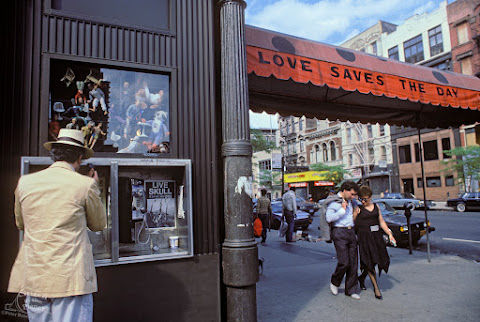
Bennett, a native New Yorker who now resides in Los Angeles, recently shared more photos from the era. He grew up in Greenwich Village and lived in the East Village from 1979 to 1988. (You can read more about him here.) He gave us permission to post these EV street scenes from the 1980s. (Top photo is outside the former Love Saves the Day on the NW corner of Second Avenue and Seventh Street.) 

Here are a few more shots from his archives (click on the image to go big)  ...  

St. Mark's Place...
Second Avenue at Seventh Street...
Second Avenue at St. Mark's Place (NW corner) ...
Second Avenue at St. Mark's Place (SW corner) ...
Seventh Street between First Avenue and Second Avenue...
Fifth Street at Avenue D ...
Fifth Street near Avenue C...
There are some more photos here. 

If you liked these, perhaps we can have an encore one of these days. Thanks to Peter for sharing!

Wednesday, January 19, 2022

A Perfect Ending

Text by Julius Klein
Photo by Tom Warren

It was around 5:30 a.m. and time for me to go home. I was leaving “Delia’s” on East Third Street, one of the many after-hour joints on the Lower East Side in the late 1980s (though with the night’s cocaine use, I probably could have hung out another couple of hours or so). I didn’t even bother to zip up my jacket against the cold and sleet, the coke’s superman quality, and as I was just a block and a half skip (or stumble) away from my apartment on Avenue B and Fourth Street.

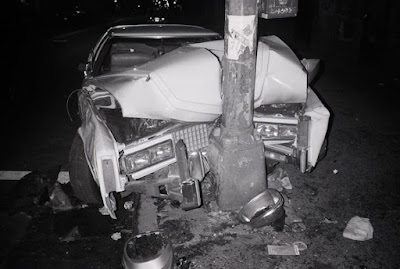
Walking east toward Avenue B in the vacant, orangey street-lit darkness, I heard a siren screaming toward me. I was at the corner, in front of the rolled-down Chinese take-out place; I could see lights speeding my way up to Third Street. A cop car in hot pursuit of a goldish Cadillac Eldorado, with a deep, mustard-colored, gold “Landou” roof, a classic “gangster ride” of the time.

Abruptly, the Caddy made a left, tires screeching, fishtailing south down Avenue B. The cop car screamed to a stop in the middle of the intersection. Two cops jumped out, guns drawn. A block away, I saw a police van flying through the intersection at Second Street and B in an attempt to head off the Caddy.

As the Cop van smashed into the rolldown of a storefront on the east side of the street, the Caddy crashed into a light pole, its hood popping up and small flames jumping out. The guy staggered out with a shotgun, and as he shoots (I was then crouched behind a convenient mailbox), the cops nailed him from both sides.

Before falling flat back, the “perp” gets off one more blast towards the sky. BAMM! “Fuck heaven, I’m going to hell” might have been his very last, tapering off thought?

The cops cautiously moved in, guns, wisely still drawn. I followed behind a dozen paces or so. The guy was clearly dead, lying face up, eyes open, in the wet gutter; snowy water pooling around his husky body as his blood joined the little, frosty stream.

Lit by the small fire under the smashed hood, and the now tilted street light, as well as the disco-y, red and blue, swirling siren lights, I could see a man, 50, 60ish, tan, in his leather, cream-colored “members only” jacket, open, his grey knit shirt slightly pushed up, exposing his belly. He had a thick gold chain around his neck, a gold belt buckle, a gold bracelet peeked out of his sleeve, a gold watch on the other. Maybe an Italian guy? Dressed very neatly and expensively in the style of his glory days, a decade or so before.

As a fire engine rolled up and several other vehicles arrived, a cop, now telling me to get back, I asked, “what’d he do?”

The cop answered that the guy “dumped a body, in an empty lot, over by Avenue D,” something fairly common at that time.

I took one last look down at the fellow and could see that this was his perfect ending, something he probably thought of many times through his years, an ending he probably discussed frequently with his criminal colleagues.

Some months later, maybe even a year or so later, I saw in some East Village gallery, a large photo print of the end of that very grim scene, by my colleague, the excellent photographer, Tom Warren, who kindly gave me the OK to use it to illustrate my little recollection.

The book, “The 1980s Art Scene in New York,” can be viewed through Jan 31, and ordered online at pulpogallery.com. (Germany)

Wednesday, February 12, 2020

'David Vega’s East Village'


An EVG reader just shared this with me... The Solas Studio, 117 E. 24th St. (2nd floor) between Lexington and Park, is presenting a 1980s photo exhibit titled "David Vega’s East Village."

The opening is tomorrow (Feb. 13) night from 6-8. Otherwise, the exhibit is open by appointment from 10 a.m. to 6 p.m. weekdays until March 13.

The exhibit coincides with a new book of his photography, "Look Back East Village 1984-1987."

And a few of his 1980s photos ...


Wednesday, August 9, 2017

A look at 'Carole Teller’s Changing New York' (and changing East Village)


[Astor Place circa the early 1980s by Carole Teller]

The Greenwich Village Society for Historic Preservation (GVSHP) has an addition to its online Historic Image Archive – a collection titled "Carole Teller’s Changing New York." (View it here.)

Here's part of an email Monday via GVSHP Executive Director Andrew Berman:

Carole is an artist who has lived in the East Village since the early 1960s, who has generously donated to GVSHP over 500 photographic images she took of Lower Manhattan and all of New York from the early 1960s to the early 1990s.

[T]hey show an incredible story of change in New York over the last half century. Carole had a keen and prescient eye catching things on the verge of change, erasure, demolition, restoration, or renewal. All her pictures capture slices of New York that are both familiar and foreign, since every one of these images captures a scene which in one way or another no longer exists, at least as portrayed.

Berman shared a sampling of Teller's photos... (all reprinted with permission)...


Bocce Court at First Park, from First Street west of First Avenue looking to south side of East Houston Street ... circa 1963...

---


50-52 Second Ave, southeast corner at Third Street ... circa late 1970s...

---


36 St. Mark's Place, south side, just west of Second Avenue, next to Gem Spa ... circa early 1980s...

---


St. Mark's Place, just west of Second Avenue ... circa 1980...

---


Second Avenue, west side between Second and Third Streets, looking south ... circa 1969 ...

---


...and an undated photo of 113 Avenue A near Seventh Street — Ray's Candy Store...

---

Prints of all these images are available for sale through the website, with proceeds benefitting GVSHP.

Wednesday, November 18, 2015

Take a walk around the East Village on this June afternoon in 1986


Another video from the archives of Nelson Sullivan arrived on YouTube yesterday.

In this 13-minute video from June 1986, Sullivan crosses Third Avenue and heads east on St. Mark's Place ... turns south on Second Avenue ... and continues on East Seventh Street to Tompkins Square Park, where he spots Lady Bunny (out of drag) and DJ Dmitry... before hanging out on A and Seventh ...


Sullivan's video archive was donated to NYU's Fales Library & Special Collections in 2012.

He died of a heart attack on July 4, 1989.

H/T EVG reader Brian K.

Previously on EV Grieve:
Take a quick trip back to Avenue A and East 7th Street in 1986

The East Village of Nelson Sullivan

The first nice Sunday of 1987 in the East Village

'The Fabulous Personalities of 1980s New York'

Friday, August 21, 2015

Take a photo vacation in 1980 New York City


[Houston and 2nd Avenue from April 1980 by Ed Sijmons]

Earlier this month, a reader sent me a 1980 NYC photo essay from the Tribeca Citizen.

Here's the premise. In the spring of 1980, Ed Sijmons and LouiseLH of Amsterdam visited New York City and took hundreds of photos ... and Sijmons recently posted them on Flickr... and passed the links on to the Citizen.

While the above photo of East Houston and the Bowery is the closest they came to the East Village, there are plentiful shots from all over the city, from the Lower East Side, Chinatown, the Financial District, Midtown... even some in Coney Island.

If you have some time to browse, then you can head over to Sijmons’s Flickr page. Look for the albums marked "NYC 1980 part1" (as well as parts 2, 3, and 4).

Tuesday, August 18, 2015

A found collection of photos from the 1980s East Village

The Wall Street Journal today has a short feature on Tony Mangia, a photographer who found a long-lost collection of his photos from the 1980s East Village. (He believed the photos were destroyed during a fire.)

His work, he said, is from the Other Paper, a twice-a-month community newspaper that covered the neighborhood from 1980-1982.

The collection ranges from quiet images of dilapidated buildings to the Ninth Precinct narcotics squad (a crew usually donning Yankees caps known on the street as the “Baseball Team,” according to Mr. Mangia) making a drug bust. The images are reminiscent of a time when the city was “dirty, dangerous and way more interesting than today,” Mr. Mangia said.

You can find the article and a selection of the photos here.

Thursday, July 16, 2015

The NYC films of BAM's 'Indie 80s' series


[From "Blank Generation"]

BAMcinématek's sprawling "Indie 80s" program, co-presented with Cinema Conservancy, starts tomorrow (out in Brooklyn, yes)… and runs through Aug. 27.

In total, there are more than 60 films "spotlighting the independent films of the neglected decade between the golden age of 70s New Hollywood and the indie boom of the 90s."

Of particular interest are the dozen or so titles filmed in New York City, including in the East Village with "Alphabet City," "Blank Generation" and "Landlord Blues."

We asked David Reilly, who has been a programmer for BAMcinématek since 2011, a few questions about the "Indie 80s" program.

In terms of these various NYC features, what were you looking for to fit into the "Indie 80s" series?

We sought out fiercely independent, personal films that in some way reflect what we’ve described as “an aesthetic and political rebuke to the greed-is-good culture of bloated blockbusters and the trumped-up monoculture of Reagan-era America” – an attitude that’s on display in abundance in New York’s creative community of the era and certainly not limited to a specific community or “scene.”

You can see this in the incredible diversity of neighborhoods and cultures represented onscreen: from CBGB punks ("Blank Generation") to Bronx hip-hop pioneers ("Wild Style"), from the gay community at the height of the AIDS crisis ("Parting Glances") to the Puerto Rican community in pre-gentrification Williamsburg ("Los Sures"), from Upper West Side intellectuals ("My Dinner with Andre") to Fort Greene’s “Brooklyn Boheme” black arts scene ("She’s Gotta Have It"), and beyond. There’s an embarrassment of riches in New York indies during this period, and we’ve tried to capture at least a small slice of that pie.

Do you see any common themes emerge from the various films about New York City during this time period?

A recurring sense of struggling to get by and live outside the system during a violent, troubled moment in the City’s history. There’s a certain ominousness and anxiety embedded in the Ed Koch Era, and it seeps through these films in a variety of forms: sexual predators ("Ms. 45"), scumbag landlords ("Landlord Blues"), roving street gangs ("Vigilante" and "Alphabet City"), homelessness ("Sidewalk Stories"), and of course, the devastation of AIDS.

What kind of legacy do you think the NYC films in the series have … particularly on the 90s indie boom?

For New Yorkers, these films are a crucial document of a very different city that’s becoming more and more unrecognizable with each passing day, and a period of explosive creativity the likes of which we may never see again.

And it’s hard to imagine a phenomenon like "Kids" (1995) — a scrappy New York story made with a mostly non-professional cast getting a major distribution deal and grossing over $20 million — being possible without these 1980s predecessors paving the way for a larger cultural awareness of independent filmmaking.

---

And here are a few of the NYC/EV-based films on the docket…

Alphabet City (1984)
Directed by Amos Poe. With Vincent Spano, Michael Winslow, Kate Vernon.
Nineeteen-year-old Johnny (Spano) is an East Village drug kingpin with the white Pontiac Firebird to prove it. But when he decides to go straight, he finds that the mob that made him isn’t going to let him off that easily. Punk filmmaker Amos Poe crafts a luridly expressionistic gangster saga set amidst the neon- splashed mean streets of the Lower East Side. The echt-80s, synthpop soundtrack is by Chic’s Nile Rodgers.
Wed, Aug 26 at 9:30 pm


Blank Generation (1980)
Directed by Ulli Lommel. With Carole Bouquet, Richard Hell, Ulli Lommel.
Punk icon Richard Hell stars as a volatile rocker having an affair with a French journalist (Bouquet) in this grimy glimpse of New York’s punk underground. Capturing the raucous energy and seedy atmosphere of the 80s downtown scene, Blank Generation features Hell and his band the Voidoids performing classics like the title track and “Love Comes in Spurts” at CBGB, as well as an appearance by executive producer Andy Warhol. Digital.
Thu, Jul 30 at 7 pm

Landlord Blues (1986)
Directed by Jacob Burckhardt. With Mark Boone Junior, Richard Litt, Raye Dowell.
An East Village bicycle shop owner (Boone Junior) takes matters into his own hands when his scumbag landlord (Litt) tries to evict him. Set against the first wave of gentrification to sweep through downtown, this ultra-rare, shot-on-16mm tenant’s revenge tale features footage of the former East 13th St. squats as well as music and an appearance by Nona Hendryx. 16mm.
Mon, Aug 10 at 7pm; Q&A with Burckhardt

Ms. 45 (1981)
Directed by Abel Ferrara. With Zoë Lund.
The ne plus ultra of women’s revenge movies, Abel Ferrara’s exploitation classic takes place in the cesspool of 80s New York, where mute garment district worker Thana (Lund) is raped once, twice—and then snaps. Packing a pistol and clad in leather (and later a nun’s habit), Thana handily wastes a good chunk of Manhattan’s male population, while Ferrara, defying the grindhouse trappings, forges a feminist statement in extremis. DCP.
Sat, Aug 15 at 4:15, 9 pm

Parting Glances (1986)
Directed by Bill Sherwood. With Richard Ganoung, John Bolger, Steve Buscemi.
This marvelously witty, compassionate snapshot of Manhattan’s 1980s gay community was one of the first films ever to lend a human face to the HIV crisis. New York City couple Michael (Ganoung) and Robert (Bolger) grapple with the emotional fallout of their impending separation and the illness of a friend (Buscemi, memorable in his first major role) dying of AIDS.
Tue, Aug 4 at 7:30, 9:30 pm

Vigilante (1983)
Directed by William Lustig. With Robert Forster, Fred Williamson, Richard Bright.
Grindhouse auteur William Lustig (Maniac) serves up a crazily violent bloodbath in this twisted, pure-pulp thriller. When gang members attack his wife and kill his son, a Queens factory worker (Forster) joins up with an outlaw vigilante group and makes it his personal mission to clean up the streets. “Directed with classical, self-effacing skill” (Dave Kehr, The New York Times), Vigilante is a grim, grimy time capsule of 1980s New York City. 35mm print courtesy of the Cinema Conservancy Archive.
Thu, Jul 30 at 4:30, 9:30 pm Intro by William Lustig


Vortex (1982)
Directed by Beth B & Scott B. With James Russo, Lydia Lunch, Bill Rice.
Noir meets No Wave in this paranoid punk thriller from New York downtown agitators Beth and Scott B. Attitudinal underground musician Lydia Lunch (Teenage Jesus and the Jerks) stars as a no-BS, leather- clad detective investigating the murder of a politician in a futuristic dystopia of corporate corruption. The Bs make the most of a miniscule budget with stylish visuals, hardboiled dialogue, and an unsettling soundtrack. 16mm.
Mon, Aug 10 at 9:30 pm

Wild Style (1982)
Directed by Charlie Ahearn. With Lee Quiñones, Sandra Fabara, Patti Astor.
The original hip-hop movie, Wild Style was the first film to document the scene’s music, breaking, and street art at its inception. It follows a subway tagger named Zoro (played by graffiti legend Quiñones) through the vibrant street culture of the Bronx in the early 80s. Filmed with semidocumentary authenticity, Wild Style features appearances by seminal artists like Grandmaster Flash, Cold Crush Brothers, Lady Pink, Fab 5 Freddy, Busy Bee, and more.
Fri, Aug 21 at 7 pm

For the full program and tickets, go here.